Hi! Another 9V battery was dead in my 830 multimeter. I've used this situation to make some modifications. I have a lot of half empty AA and AAA batteries, so I decided to power up multimeter from 1.1V (fresh AA/AAA have 1.5V).
Monday, August 22, 2016
DIY solder smoke absorber
Hi! As you could note my hobby is electronics =) So solder station is my frequently used tool. Long time I've used it without smoke absorber. I think that it is really useful thing =) I had a choice: buy it or make it. Of course, the simplest way is to buy, but I'm not looking for simple ways).
So I've decided to make something like this:
Update: Device is complete =)
Tuesday, July 26, 2016
AM2320 library for AVR's without hardware TWI support
Hi! Some time ago I've bought several AM2320 sensors. They have I2C interface, so it is very easy to use them with AVR's that have h\w TWI support. But what about low-end MCU's without full TWI implementation (Tiny2313, Tiny24, etc.)?
First I tried to use USI module for TWI implementation. As for me resulting code was too "fat" for 2Kb FLASH and there was no need for full TWI feature support (the only TWI device in my project was AM2320).
After some time spent on datasheet reading and hardware testing I've wrote a C library for these sensors. Please note that AM2320_ReadData function writes raw data to variables. This notice is actual for negative temperature values, where 0x8000 bit is set.
AM2320 Datasheet
First I tried to use USI module for TWI implementation. As for me resulting code was too "fat" for 2Kb FLASH and there was no need for full TWI feature support (the only TWI device in my project was AM2320).
After some time spent on datasheet reading and hardware testing I've wrote a C library for these sensors. Please note that AM2320_ReadData function writes raw data to variables. This notice is actual for negative temperature values, where 0x8000 bit is set.
AM2320 Datasheet
Sunday, January 31, 2016
Driving MOSFET's in a cheap way
Hi all!
As you know MOSFET-s are definitely best choice for switching-mode applications. But in most cases they need a gate driver circuit to work properly (of course, if you don't want o make a heater =)). There are lots of driver IC's, but I decided to go another way and test simple discrete driver.
Few days ago I bought some BJT's: SS8050 and SS8550. they are fast (~150-200 MHz), have high collector current (0.7A continuous, 1.5A pulse). Vce is about 20V (most FET's Vgs value).
So I've made two drivers on a breadboard: N-FET low-side and N-FET high-side with bootstrap.
To drive MOSFET(Q1) 8050 and 8550 BJT's are connected as totem-pole emitter follower. I've tested these drivers with 5V signal source, so I've added an inverting level shifter (Q6, R26). If TL494 (for example) is used as control source there is no need in level shift in most case.
Load was 12V 21W auto lamp (~1.8A). MOSFET was without any heatsink. Control signal: square wave generator with PWM on TL7555 timer with output buffer (74HC04). Frequency: 2KHz to 70 KHz.
As you know MOSFET-s are definitely best choice for switching-mode applications. But in most cases they need a gate driver circuit to work properly (of course, if you don't want o make a heater =)). There are lots of driver IC's, but I decided to go another way and test simple discrete driver.
Few days ago I bought some BJT's: SS8050 and SS8550. they are fast (~150-200 MHz), have high collector current (0.7A continuous, 1.5A pulse). Vce is about 20V (most FET's Vgs value).
So I've made two drivers on a breadboard: N-FET low-side and N-FET high-side with bootstrap.
To drive MOSFET(Q1) 8050 and 8550 BJT's are connected as totem-pole emitter follower. I've tested these drivers with 5V signal source, so I've added an inverting level shifter (Q6, R26). If TL494 (for example) is used as control source there is no need in level shift in most case.
Load was 12V 21W auto lamp (~1.8A). MOSFET was without any heatsink. Control signal: square wave generator with PWM on TL7555 timer with output buffer (74HC04). Frequency: 2KHz to 70 KHz.
Saturday, January 30, 2016
Light for Dremel Workstation 220. New version.
Hi!
About two years ago I've made a work area lighting for my Dremel Workstation 220. Really simple - 3AA batteries, resistor and a bunch of white LEDs (all in parallel) from broken flashlight. Not bad, but these LEDs have narrow light spots and large power consumption.
Tuesday, November 24, 2015
Thursday, April 2, 2015
My Electronics Calculator
Due to Google Code is closing, code repository and builds were moved to SourceForge. Also new build (b72) is available.
Welcome =)
Saturday, January 17, 2015
74HC595 breakout board
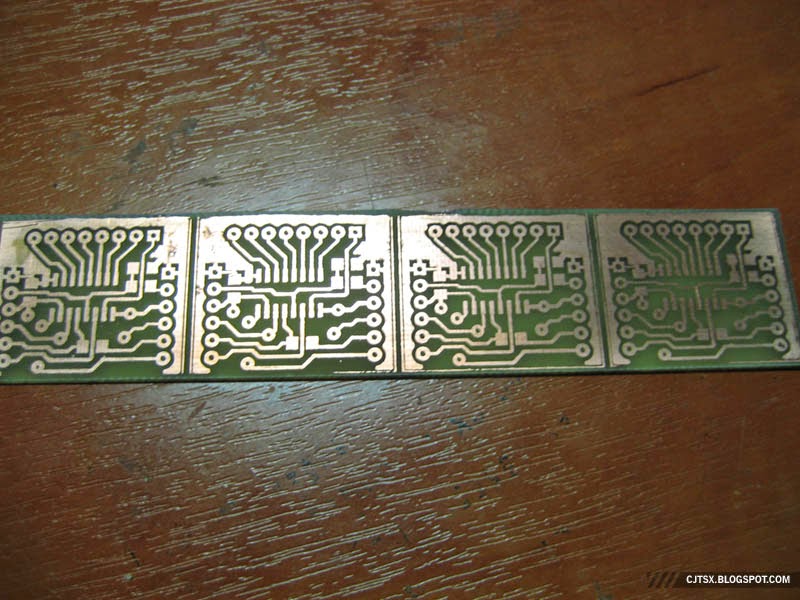
Recently I've bought a bunch of cheap 74HC595 shift register IC's. But SOIC case is not suitable for solderless breadboard. I didn't want to buy this IC's in a DIP case too, so I've made my own breakout board for them.
Single side PCB with 3 jumper wires on top side. Not so small as Adafruit's (for example), but easy to make with laser printer and iron. Supports daisy chain.
| Etched PCB's |
Tiny glue gun mod
Some time ago I've bought a really cheap and simple glue gun. Device works fine, but there was no power-on indication.
Today I decided to make tiny device update =)
| Disassembled gun |
Wednesday, November 26, 2014
Eggs in a microwave oven
An attempt to cook eggs in a microwave oven.
- Grease cup with cooking oil
- Break 2 eggs
- Put cup to oven
- ...wait
- Profit?
Ok, let's try =)
Subscribe to:
Posts (Atom)